
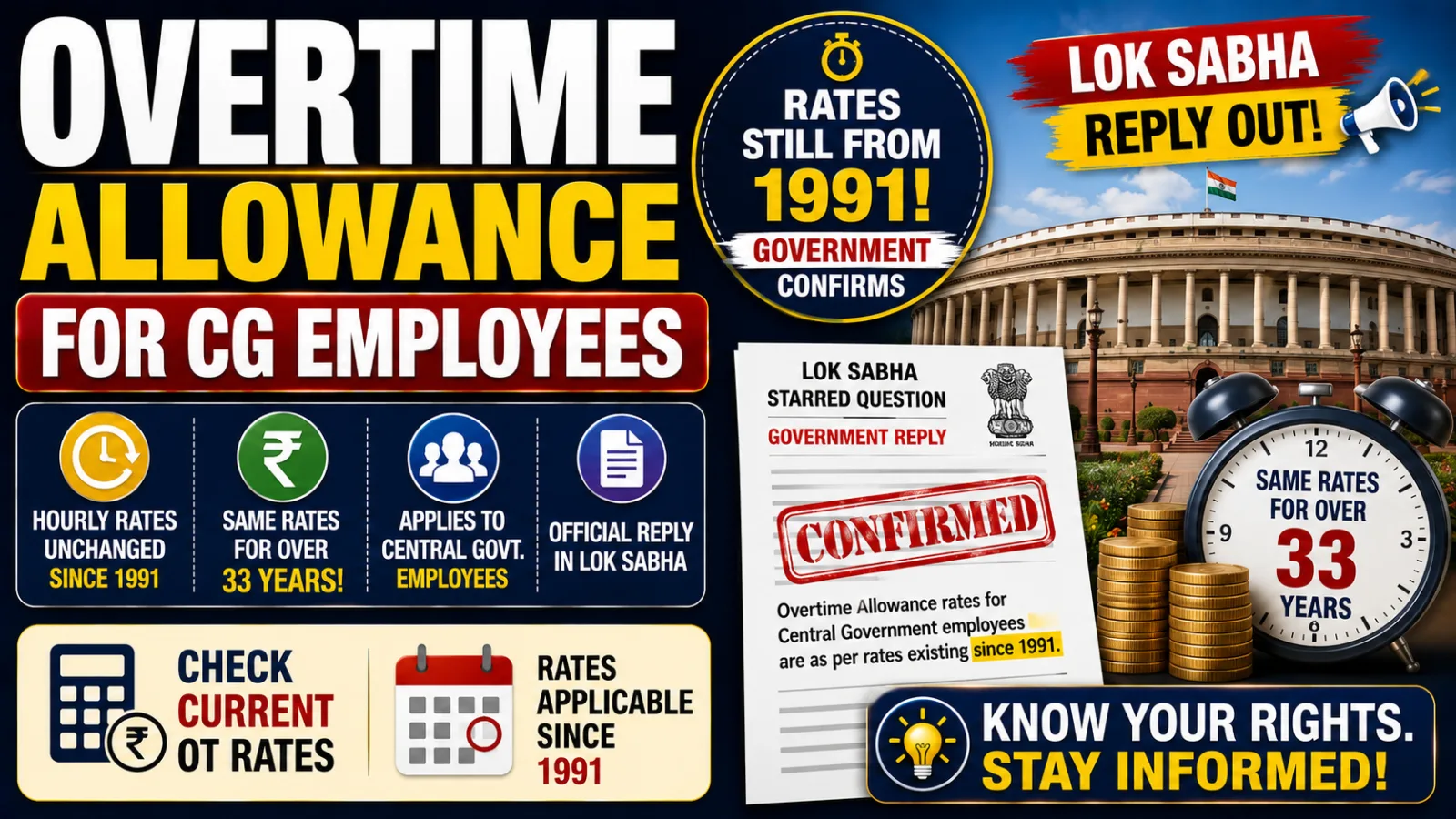
If you've assumed overtime allowance for Central Government employees follows the newer Code on Wages formula — double the normal wage rate — the Government's answer in Parliament sets the record straight, and it's not what most people expect. Overtime Allowance (OTA) for Central Government employees runs on its own, much older track, with hourly rates that haven't moved since 1991 and a scheme that's been discontinued for most employees altogether.
This is Lok Sabha Unstarred Question No. 2775, answered on 5 August 2026 by Dr. Jitendra Singh, Minister of State in the Ministry of Personnel, Public Grievances and Pensions, in response to a question by Shri Radhakrishna.
What Was Actually Asked
The question, in three parts, tested a specific assumption:
- Is overtime allowance paid to non-gazetted Central Government employees computed as per the rate prescribed under Section 14 of the Code on Wages, 2019 — not less than twice the normal rate of wages — since that Code was implemented on 21 November 2025?
- What's the existing formula and rate for OTA, and since when has it remained unrevised?
- Is there any proposal to extend OTA payment to Gazetted Central Government employees, who are currently excluded?
The Government's Answer: No, It Doesn't Follow the Code on Wages
This is the headline finding. The Government's reply makes clear that OTA for eligible Non-Gazetted Central Government Employees is not governed by the Code on Wages, 2019 rate formula. Instead, it's regulated based on the recommendations of successive Pay Commissions.
The most recent governing order is OM No. A-27016/03/2017-Estt.(AL), dated 19 June 2018, issued following the Department of Expenditure's decision on the 7th Pay Commission's recommendations. That OM did something significant: it discontinued OTA for all categories of Central Government employees, except Operational and Industrial employees who are covered under separate statutory provisions.
In plain terms: if you're a general Non-Gazetted Central Government employee today, you very likely don't get OTA at all anymore — it was withdrawn for most categories back in 2018, on the 7th CPC's recommendation. The people still eligible are a specifically carved-out group covered by statutory obligations, not the general workforce.
The Rates Haven't Moved Since 1991
For the employees who are still eligible — Operational and Industrial staff under statutory provisions — the hourly OTA rates were prescribed via OM No. 15012/3/86-Estt.(Allowance), dated 19 March 1991. According to this reply, those rates have not been revised since, based on the Department of Expenditure's decisions on successive Pay Commission recommendations.
That's 35 years without a rate revision, even as basic pay, dearness allowance, and virtually every other component of Central Government compensation has been revised multiple times over the same period through the 6th, 7th, and now pending 8th Pay Commissions.
No Plan to Extend OTA to Gazetted Employees
On the third question, the answer is short and direct: decisions on allowances, including OTA, rest with the Department of Expenditure, based on Pay Commission recommendations. There's no indication in this reply of any proposal currently under consideration to extend OTA payment to Gazetted employees, who remain excluded as they have been.
Why the Code on Wages Confusion Exists
It's an understandable mix-up. The Code on Wages, 2019 — a genuinely significant piece of labour legislation that consolidated several older wage-related laws — does set out a general principle under Section 14 that overtime work should be paid at not less than twice the normal wage rate. Since the Code came into force on 21 November 2025, it's reasonable that people assumed it would automatically apply to Central Government employees' OTA calculations too.
But Central Government service conditions, including allowances like OTA, are governed by their own service rules and Pay Commission-driven Office Memoranda — not directly by the Code on Wages, which primarily governs the broader employer-employee wage relationship across industries. This reply confirms that distinction explicitly, at least as things currently stand.
What This Means for You
- If you're a general Non-Gazetted Central Government employee, don't expect OTA — it was discontinued for your category back in 2018, following the 7th CPC's recommendations
- If you're Operational or Industrial staff covered under statutory provisions, you remain eligible, but at hourly rates fixed in 1991 — check your specific rate against your department's current OTA calculation to confirm it matches
- If you're Gazetted, there's no current proposal to bring you into OTA eligibility
- Don't assume the Code on Wages, 2019 rate applies to your OTA calculation as a Central Government employee — per this reply, it doesn't
Why This Might Come Up Again
With the 8th Pay Commission currently working through its consultation and analysis phase, allowance structures — including whether a scheme like OTA gets revisited, revived for wider categories, or its 1991 rates finally revised — are exactly the kind of issue that could surface in union memoranda submitted to the Commission. Whether it actually gets addressed remains to be seen, but this is a live grievance point worth watching as the Commission's work progresses.
For a broader understanding of the allowances Central Government employees are entitled to today, our Central Government allowances guide is a useful reference. For the latest on where the 8th Pay Commission's process stands, see our 8th Pay Commission latest updates roundup.
For more official Parliament replies like this, follow our government news section.