
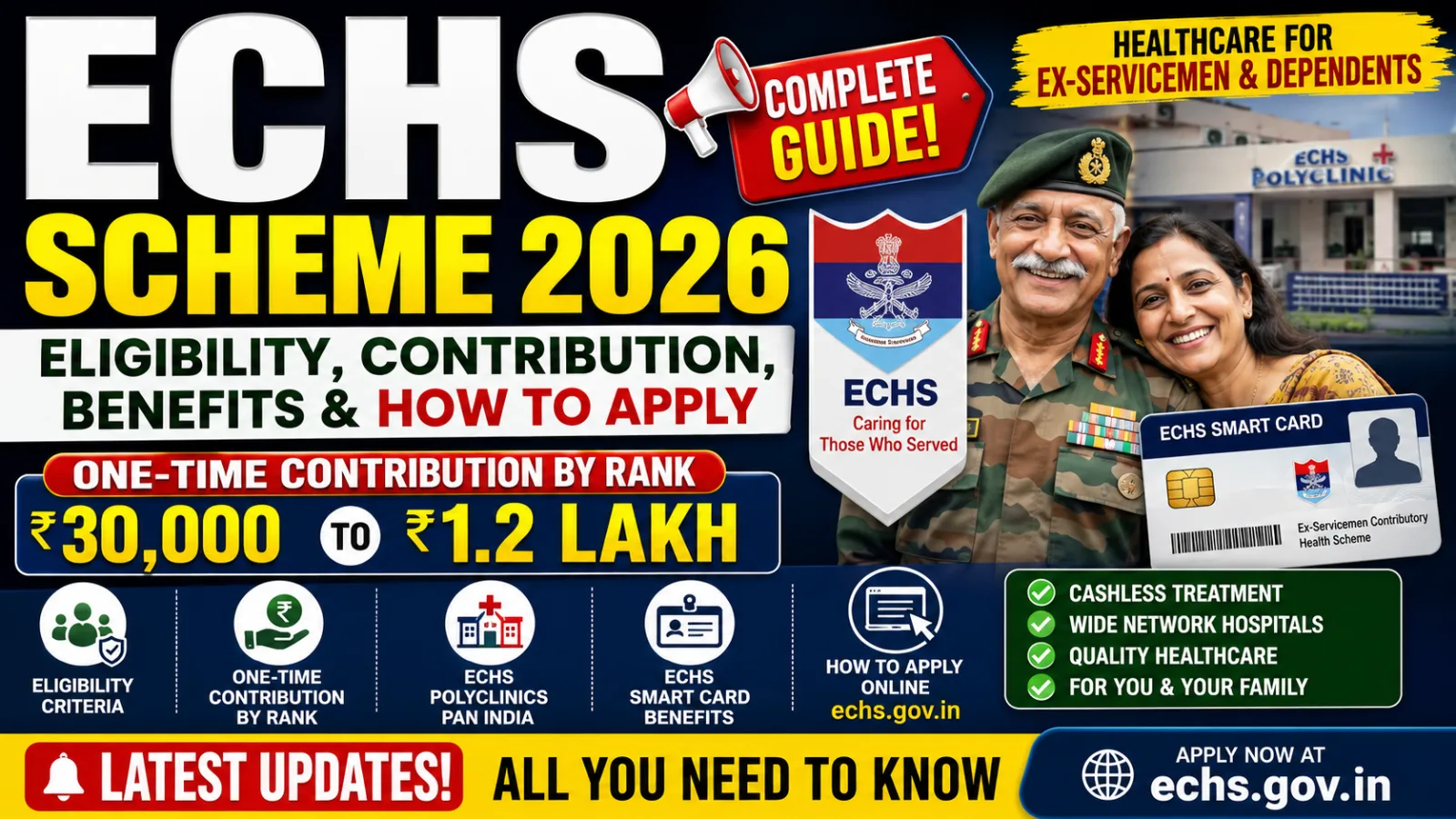
For a retired soldier, the ECHS Scheme is often the single most valuable benefit after the pension itself — lifelong, largely cashless healthcare for the whole family for a one-time contribution. But many veterans are unsure who qualifies, how much it costs and how to get the card. Here is the clear 2026 guide to eligibility, the contribution by rank, the benefits and how to apply.
What the ECHS Scheme is
The ECHS Scheme — the Ex-Servicemen Contributory Health Scheme — was approved by the Government of India in December 2002 and launched on 1 April 2003. It gives ex-servicemen and their dependents outpatient and hospital care through a network of dedicated ECHS polyclinics and empanelled hospitals, mostly cashless.
Who is eligible
Membership is open to:
- All ex-servicemen drawing a pension from the Controller of Defence Accounts, including disability and family pensioners
- War widows (Veer Naris) and dependents of soldiers who died in service
- Eligible dependents — spouse, dependent children within age limits, and dependent parents whose income is within the prescribed limit
ECHS contribution amount by rank
The scheme is contributory — a one-time payment based on the rank held at retirement:
| Category | One-time contribution |
|---|---|
| Other Ranks / lower ranks | from ≈ ₹30,000 |
| Officers | up to ≈ ₹1,20,000 |
No contribution is required if you are war-disabled, a war widow, or retired before 1 January 1996.
Benefits and the ECHS smart card
- Cashless treatment at ECHS polyclinics, empanelled hospitals and diagnostic centres
- OPD, inpatient care, specialist consultations, diagnostics and pharmacy benefits
- Access to 427+ polyclinics across India (and 6 in Nepal)
- A secure ECHS smart card (64 KB) storing medical history and referrals, verified via Aadhaar and fingerprint
How to apply for ECHS
- Apply online at echs.gov.in through New Member Registration, or offline at an ECHS polyclinic or Regional Centre.
- Submit the form with the required documents.
- Pay the one-time contribution based on your rank.
- After verification, the ECHS smart card is issued and you can start using polyclinics and empanelled hospitals.
What ECHS covers
The scheme is designed to be comprehensive rather than a top-up:
- Outpatient (OPD) consultation and medicines at polyclinics
- Inpatient (hospital) treatment at empanelled hospitals, largely cashless
- Specialist consultations, surgeries and diagnostics on referral
- Pharmacy and routine investigations
Treatment usually starts at your parent polyclinic, which refers you to an empanelled hospital or specialist when needed. Emergencies can be taken directly to an empanelled hospital. Because the network is nationwide, members can use polyclinics while travelling or after relocating — which makes ECHS especially valuable for veterans who move around the country.
ECHS vs CGHS — which applies to you
ECHS is for ex-servicemen and their families; CGHS is for serving and retired central government (civilian) employees. If you are a civilian central government employee, read our detailed CGHS complete guide instead. Both offer cashless treatment but through separate networks and cards.
Related guides and tools
Ex-servicemen should also see our CSD car purchase guide, the CSD Canteen Smart Card limits and the CSD AFD online portal guide. For more defence pay and benefits guides, visit the CG Seva homepage.
Check your pension and pay with our free tools:
- 🏅 Defence Pension Calculator — OROP and pension estimate.
- 🎖️ Defence Pay Calculator — military pay with MSP by rank.
- 📄 Salary Slip Generator — build and download your payslip.
Quick summary
- The ECHS Scheme gives ex-servicemen and dependents lifelong, largely cashless healthcare for a one-time contribution.
- Eligibility: all pension-drawing ex-servicemen (incl. disability/family pensioners), war widows and eligible dependents.
- Contribution: ≈ ₹30,000 to ₹1,20,000 by rank; free for war-disabled, war widows and pre-1996 retirees.
- Network: 427+ polyclinics plus empanelled hospitals; secure Aadhaar-verified smart card.
- Apply: online at echs.gov.in or at any ECHS polyclinic.