
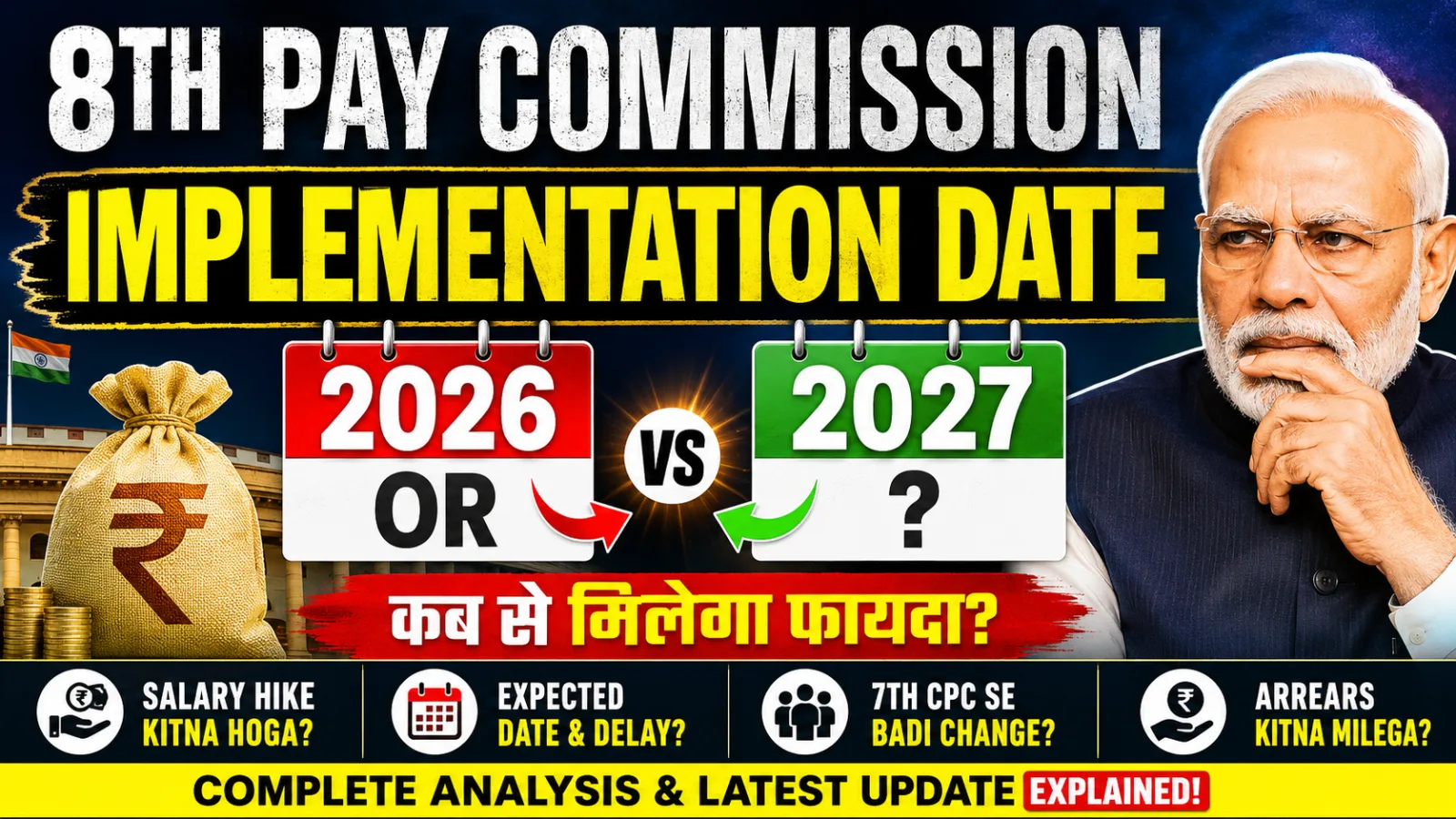
"When will the money actually reach my account?" That is the question behind every search for the 8th Pay Commission implementation date. People don't want a paper effective date — they want to know the month their salary changes. I've lived through two pay commission rollouts, so let me give you the realistic answer, not the hopeful one, by walking through how every past commission has actually played out.
Effective date vs payment date — settle this first
This is the single most misunderstood point.
- The effective date is the date from which your revised pay applies on paper.
- The payment date is when the revised salary actually starts hitting your account.
These are almost never the same. The revised pay is usually made effective from a clean date (historically 1 January), but the notification and first payment come months — sometimes a year or more — later. The gap is paid out as arrears.
The pattern from past commissions
Every pay commission has followed roughly the same rhythm:
| Stage | Typical duration |
|---|---|
| Commission constituted | — |
| Report submitted | ~18–24 months later |
| Government accepts + notifies | ~2–6 months after report |
| Revised pay credited | shortly after notification |
| Arrears paid | from the effective date |
The 7th CPC was constituted in 2014, submitted its report in late 2015, and was notified in mid-2016 with effect from 1 January 2016 — arrears covering the gap were paid afterward.
So what is the realistic 8th Pay Commission implementation date?
As of July 2026, the 8th CPC has been constituted and its Terms of Reference approved, but the commission has not yet submitted its report. Applying the same pattern:
- Effective date: 1 January 2026 — consistent with the 10-year cycle from the 7th CPC's 2016 effective date.
- Notification and first revised payment: likely 2027 — after the ~18-month report and government approval.
So even if your salary doesn't change on 1 January, the effective date being 1 January means you accrue arrears from that point. The money isn't lost; it's deferred.
Why the 2027 payout could be large
Two things stack up in your favour by the time payment actually happens:
- Arrears accumulate from the effective date to the payment date — potentially 12–18 months of the difference between old and revised pay.
- Your DA keeps rising until implementation (60%, moving to ~63% from July 2026), and that higher DA is effectively merged into the new basic — raising the base the revised pay is built on.
Together, these can make the first revised payment plus arrears a sizeable lump sum.
What not to do
- Don't treat any single date as official until there is a gazette notification.
- Don't assume no arrears — historically the effective date is backdated, so you are owed the gap.
- Don't ignore the tax angle. A large arrears lump sum is taxable in the year received; Form 10E / Section 89(1) relief can spread it across the relevant years and soften the hit.
The bottom line on the 8th Pay Commission implementation date: plan for an effective date of 1 January 2026 but payment in 2027, with arrears making up the gap. And once you know the timeline, the other half of the story is how much — which comes down to the fitment factor: 1.83 vs 2.86. You can track official updates at the government portal, 8cpc.gov.in.